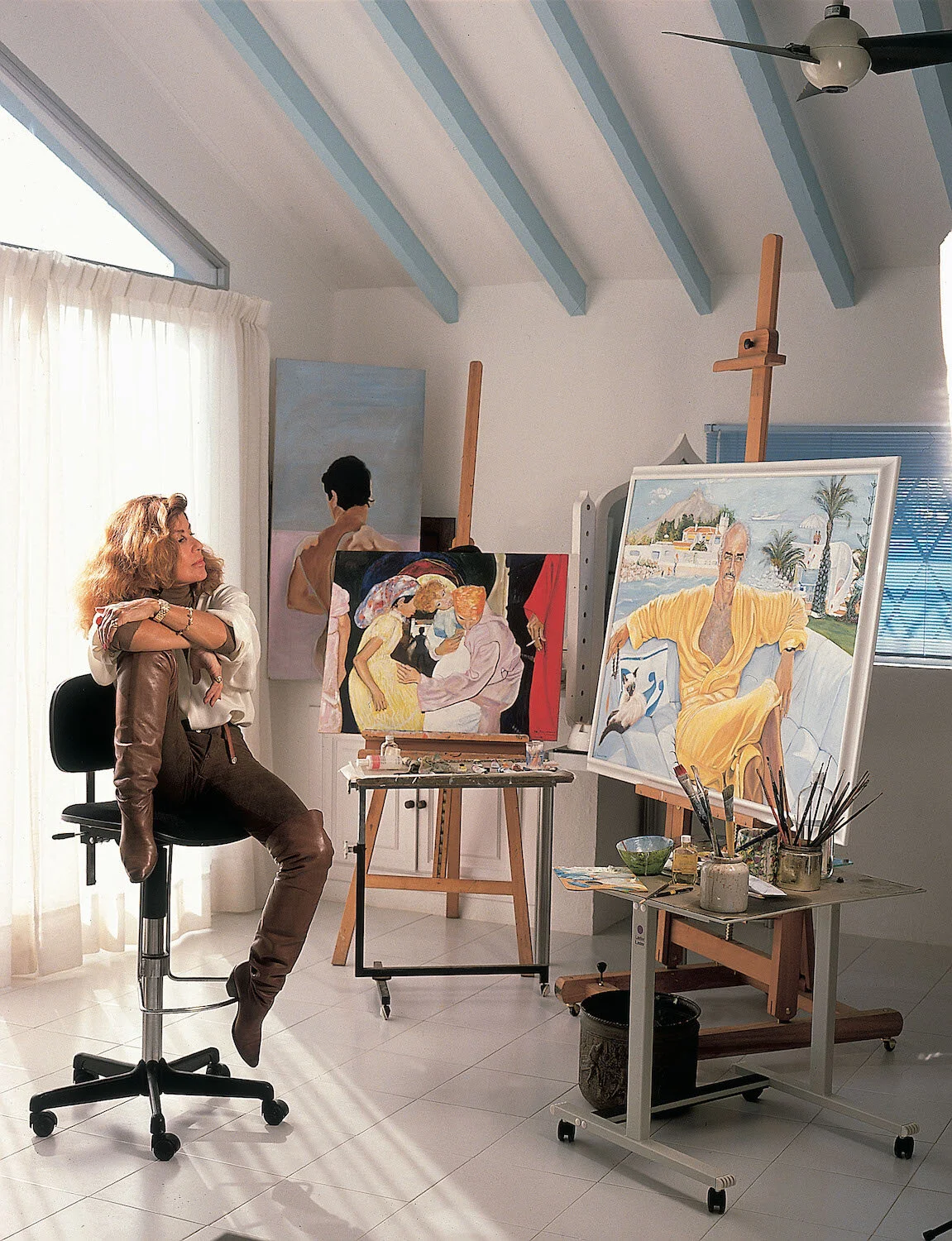
MICHELINE ROQUEBRUNE CONNERY
Interviewed by Alexander Apsis
December 2000
Self-Portrait, 1962, oil on panel, 66 x 54.6 cm
Saskia Eye, 2004, oil on panel, 61 x 76.8 cm
John Huston, 1975, charcoal on paper, 23 x 30.5 cm, signed lower right "Micheline Roquebrune Connery”
Reflections in Water (Red Boat), 1994, oil on canvas, 84 x 100 cm, signed lower right "M. Roquebrune”
After the Prayer, 1985, oil on panel, 89 x 117 cm (Permanent Collection of the First National Museum of Women in the Arts, Washington, D.C.)
Beauty Asleep (Samara), 2010, oil on panel, 122.6 x 57.2 cm
“I know it’s more fashionable to paint sinister and tormented. I tried it on several paintings. First, it depresses me immensely and secondly, I believe looking at a painting should be an uplifting experience. And, although I am aware of the fine line between optimism and kitsch, it is my nature to evoke an upbeat feeling. ”
AA: You describe yourself as a self-taught artist. When, why and where did you begin?
MRC: I lived in Tunisia as a child, there were always painters and sculptors at my parents’ house. One of them, a Russian, Alexandre Roubtzoff, was staying with us almost permanently. I posed for him often and hated it. His work is shown in many museums and in the Orientalist Art books. From the age of seven to fourteen, I was in a convent where no art was taught. Then, until the Baccalaureat, I was at the Lycée in Tunis where Art was facultative. I avoided it completely. But I always visited museums and art galleries.
At 23 I went one day to Galerie Charpentier in Paris and I was appalled by what I thought and judged as very poor-quality pieces of so called “Art”. My reaction was, “Why don’t I try...must not be that difficult”. At the time, I had two children and was living in Casablanca, Morocco. I had not a clue about mediums to paint. I decided to paint a self-portrait. I sat in front of a mirror, looking at myself at a three-quarter angle. And I did it in one session of five hours almost uninterrupted. The result was surprising. It was me, looking very nasty, mouth tightly closed. The three-quarter pose was exhausting, and I had a terrible headache afterward. I had chosen oil paint for the making of the portrait. Being aware of my total ignorance, I asked the director of the Academy des Beaux Arts, a friend of a friend, and quite a known painter if he would come to my house to show me how to paint. I would provide the paint, the canvas, and a model. I would just look at him working. He kindly accepted. First session three hours. I did not see much result. Second session...not much either. Between the second and third session I decided to paint the head of my gardener, black old man with his white turban of “Hadj”. I finished the portrait in three hours. The painter came for the third time, he saw the gardener and the portrait, looked at it for a long time, took a piece of cloth, some turpentine and erasing his whole canvas, said, “You know much more about portraiture than me, just continue”. That was my first and last lesson in painting or drawing. I began to paint and draw like crazy night and day. It had been the devouring passion of my life. I realized quickly that when I look at people, I draw them in my head. I don’t see them; I see the features. I can draw with my right or my left hand the same way.
AA: Why did you first embark on portraiture and why was portraiture such a predominating theme in your painting particularly in the early years?
MRC: Because I began with my portrait. I think I was interested in people, in features.
AA: Are you particularly interested in people?
MRC: I am particularly interested in expression and I thought if I was very humbly copying features that I saw with shade and light because, after all, it is only a question of shade and light, then the person would be exactly as they are.
AA: You say you were interested in expression. What artistic liberties do you take to accentuate the expression in portraiture?
MRC: Well, I think I do it without knowing. I am very interested in eyes and I generally do them quite well. The eyes, as we say in France, are the mirror of the soul. If the eyes are expressive then it gives life to the individual.
AA: So tell me about a typical sitting, are they long? Do you go through any preliminary studies?
MRC: No, I begin immediately. I begin to study the shape of the face. I can begin by the nostril or the line of an ear. I am extremely interested by line and suddenly there is something, the nostril, for example, I try and try, it’s not his or hers, then suddenly it is and from there it’s, for me, like a puzzle. One thing leads to the other and it’s like that I make a portrait. I don’t make a line for the eyes a line for the nose, not at all, I never did that, I never tried. I just begin the portrait by any feature. Then it flows its own way.
AA: Line is clearly of great interest to you. If you look, for example, at the portrait you did of John Huston you can see that you have a great talent as a draftsman however it seems that as your work has progressed over the years and later in the 80s and the 90s your painting has become more painterly. Line is less apparent.
MRC: That’s true because in the beginning my ideal draftsman was Dürer the line was extremely important for me. By the way, I don’t think I have made any progress in drawing since the first time I began to draw. About painting, I have always been mesmerized by colors. I need color like people need air to breathe. I became much more free in color than I was in the beginning.
AA: It seems to me that the earlier works were somewhat more gothic in feeling and sterner and the later works are much more optimistic; is that a reflection of perhaps more optimism later on in life or is it purely one where you’re really looking at more modem work as opposed to the old masters?
MRC: No, no I think it’s just that I let myself go more. In the beginning I was a little tight in the way that I wanted to respect things much more than I do now about painting and drawing, the line is less important and the painting is predominant no doubt about that.
AA: I see it in the early works the portraits are all studied in a classical way which, presumably, is done from a human form, the later ones have more of a flow and you have more interest in the composition and the colors than before.
MRC: This was not premeditated. Before I begin a painting, I fear I will never be able to draw or paint again. That’s exactly the feeling I have. I have no memory of what I have done before, I suppose it is a subconscious memory. I have no recipe for painting whatsoever. I start from scratch each time.
AA: What artists would you say influenced you?
MRC: I adore Gauguin, Egon Schiele.
AA: It is interesting you say Gauguin, Egon Schiele as those are two artists who are in a way at the opposite end of the spectrum because you have a great colorist and cloisonnist in Gauguin and an extraordinary draftsman in Schiele, that obviously ran a tremendous gamut and I expect that somewhat reflects your interest in the two different yet complimenting disciplines of coloring and line.
MRC: Yes, absolutely, there is no doubt... I never thought about that.
AA: Let me ask you where do you get your inspiration from in terms of your subjects that you decide to paint?
MRC: For example, I begin to paint a reflection of a boat in water. That is unexpected—the line does not mean anything and yet when it’s painted the water is shimmering with light.
AA: Would you be out there studying the water or are you more inclined—what are your preliminary steps in every painting, is it from photography? From sketching? What are your studies?
MRC: It depends, sometimes it’s from a picture. Photography is very important because it gives you an idea but then I go to the harbor and I look at the shimmering of the light in the water, I see the color there and I repeat it. I don’t like to paint people from a photo but very often I have to because for a composition of more than one person in motion it is practically impossible to do without. I love to have model it is much easier for me than painting from a photo. If I take a photo of a boat in the water, I will finish by transforming completely and the reflection and the color of the boat. I cannot explain why.
AA: presume from looking at your work that photography was less important to you earlier on?
MRC: Yes, certainly because photography gives me more freedom in one way because I have a view of an ensemble available for a long time.
AA: Your elective medium is oil and I see you paint on panels as well as canvas, first of all, why do you like oil and secondly what is the difference between painting on panels and painting on canvas?
MRC: I love the very smooth surface of panels and also, I paint on wood panel without any preparation. I am told you must always prepare a panel or a canvas but I’m sorry, when I paint on canvas that has been prepared sometimes the painting peels over time. In panel it never happens. People think that on panel the color is not as bright as on canvas, I don’t think this is at all true. Many think I’m painting with acrylic; I never touch acrylic, it’s only oil, but my colors are very vivid. Well, as Rubens said, “Give me mud and I will make the flesh of a Venus” because it depends on the color you put beside the mud.
AA: Tell me why you have only chosen to paint with oil.
MRC: I began with oil, I like the medium. I tried pastel, I draw, I use charcoal, I never tried acrylic; I’m not tempted at all.
AA: You have never been a great self-promoter and have only just started to exhibit your paintings, can you tell us a little bit about your professional life as an artist before the recent exhibitions at the National Museum of Women in the Arts in Washington, D.C. and the Alliance Française in Chicago?
MRC: It’s true I never had any physical time to promote my paintings. Thank God, the paintings are not like tomatoes, they don’t rot. I have accumulated a large amount of paintings, about 130. I didn’t feel like making any publicity for myself, I just wanted to paint. In 1994 one of my paintings, Women Coming out of the Mosque was chosen by the National Museum of Women in the Arts in Washington D.C. to be part of their permanent collection. At that time, they invited me to make an exhibition of my work, but I only decided to give life to this proposition in April 2000. I am very pleased I did it because I was offered another exhibition in Chicago. And now I’m thrilled to be invited to have a show in Athens.
AA: But presumably you did sell paintings commercially early on?
MRC: From the age of 23 I painted and sold about 50 oil portraits. My motto was, “My price is very stiff so if you don’t adore the portrait you don’t have to take it”, which gave me total freedom to do what I wanted and the subject was free to pay for it or not. I never had one portrait refused. I was so much in demand that at one time I painted 18 portraits in 9 months. I felt I was becoming a factory. It was at that time that I decided not to do any more commissioned portraits and I began to paint for myself. A lot of nudes, landscapes, fruits, vegetables, flowers, waters.
AA: You started painting in Morocco and for a short time in England and more actively in Spain and now in the Bahamas. Apart from the evolution of your work over the years, do you see a marked difference in the way you paint in any geographic location?
MRC: People say it’s different, but I am quite blind to that aspect of my evolution.
AA: Because of the increase of interest in your paintings with the recent exhibitions do you find yourself with renewed energy to paint more?
MRC: I have had periods when I don’t paint at all and periods when I paint nonstop. I paint quite fast. I can do a lot of work in eight days and stop for one or two months.
AA: In capturing a joie de vivre in your paintings, which seems more difficult than a more tortured theme, how do you stay away from the danger of being kitsch?
MRC: I know it’s more fashionable to paint sinister and tormented. I tried it on several paintings. First, it depresses me immensely and secondly, I believe looking at a painting should be an uplifting experience. And, although I am aware of the fine line between optimism and kitsch, it is my nature to evoke an upbeat feeling.
Alexander Apsis was with Sotheby’s in London and New York for 25 years, most recently as the Director of the Impressionist and Modern Art Department in New York from 1991 until 1999. He is now a private art dealer based in New York.